
Common Movement Mistakes in Youth Athletes
🎉 New Patient Special: Full exam + X-rays if needed for only $29 (regular fee $189) — Marlboro, NJ
Book for $29 →As a chiropractor who has spent years working with young athletes throughout Marlboro and the surrounding towns, I see the same movement flaws walk through my door on repeat. A twelve-year-old soccer player with knee pain. A high school volleyball player with a sore lower back after every practice. A baseball pitcher with shoulder discomfort that “just showed up” one day. In almost every case, the root cause isn’t a single traumatic injury—it’s a movement pattern that has been quietly breaking down for months, sometimes years, before pain ever appeared.
Youth sports have become more specialized and more intense than ever before. Kids are training year-round, often in a single sport, without the foundational movement education that used to come from varied, unstructured play. The result is a generation of talented, motivated athletes who move inefficiently under load—and inefficient movement, repeated thousands of times, is the recipe for both nagging pain and serious injury.
In this post, I want to walk through the four movement mistakes I see most often in my Marlboro practice: squatting mechanics, landing mechanics, rotational control, and the timing of correction. My goal isn’t to scare parents or coaches—it’s to give you a clear, practical understanding of what to look for and what can be done about it.
Why Movement Mistakes Develop in Young Athletes
Before diving into specific patterns, it’s worth understanding why these mistakes happen in the first place. In my clinical experience, there are a few consistent drivers:
- Growth spurts outpace motor control. A young athlete’s limbs can lengthen faster than their nervous system adapts, temporarily disrupting coordination.
- Early sport specialization. Repeating the same movement patterns without cross-training leaves other muscle groups underdeveloped and creates imbalances.
- Fatigue and volume. Multiple practices, games, and tournaments in a single week don’t leave enough recovery time for proper movement patterns to reset.
- Lack of foundational coaching. Many youth programs focus on sport-specific skills without ever addressing basic movement literacy—how to squat, land, and rotate safely.
None of this is a criticism of parents, coaches, or the kids themselves. It’s simply a reflection of how youth sports culture has evolved. The good news is that these patterns are highly correctable when identified early.
The Four Movement Mistakes I See Most Often
1. Squatting Mechanics
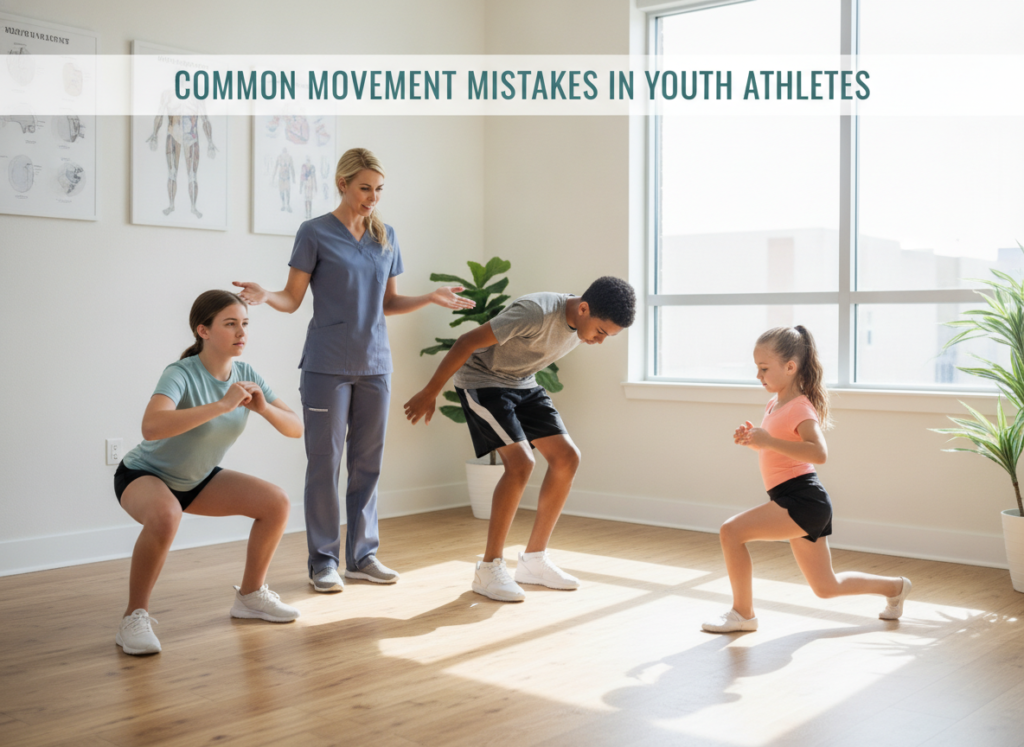
The squat is the foundation of nearly every athletic movement—jumping, sprinting, cutting, and even throwing all rely on proper hip and knee loading. In my exams, I frequently see young athletes squat with their knees caving inward (a pattern called valgus collapse), their heels lifting off the ground, or their lower back rounding excessively under load.
These compensations often trace back to tight hip flexors, weak glutes, or limited ankle mobility. Over time, poor squatting mechanics place excessive stress on the knees and lower back, increasing the risk of conditions like patellar tendinitis or early disc irritation—injuries I’d rather prevent than treat.
2. Landing Mechanics
Landing is where I see the most concerning patterns, particularly in basketball, volleyball, and soccer athletes. A proper landing should be quiet, controlled, and evenly distributed through both legs with soft knees. What I often observe instead is a stiff-legged landing, one-sided weight shift, or knees collapsing inward on impact.
This is significant because faulty landing mechanics are one of the strongest predictors of ACL injury in young athletes, especially female athletes during the adolescent growth period. It’s also a major contributor to chronic knee and ankle pain that I treat regularly in my Marlboro office.
3. Rotational Control
Sports like baseball, golf, tennis, and lacrosse demand repeated rotation through the trunk and hips. Many young athletes generate that rotation almost entirely from the lower back instead of the hips and thoracic spine, where rotation should primarily occur.
When the lumbar spine becomes the primary source of rotational force, it takes on repetitive stress it isn’t designed to handle. This is a leading contributor to the low back pain I see in youth pitchers, golfers, and racquet-sport athletes, and it’s a pattern that tends to worsen with growth spurts if left unaddressed.
4. Timing of Correction
Perhaps the most important factor isn’t the movement flaw itself, but when it gets addressed. I’ve treated athletes who came in for a first evaluation after months of nagging pain, when the same movement dysfunction could have been identified and corrected during a routine screening before symptoms ever started. Early identification consistently leads to faster correction, less time lost from sport, and lower injury risk down the road.
Ready to Feel Better? Start for Just $29
Your first visit includes a full exam + X-rays if needed for only $29 — regular fee $189. Same-day appointments available at our Marlboro, NJ clinic.
Valid for new patients only at participating locations. Due to federal regulations, this offer cannot be applied to patients enrolled in Medicare, Medicaid, or other federal healthcare programs. Not valid for ACN members. New Patient offer pricing varies by location. Insurance acceptance varies by location.
How I Approach Correction in My Marlboro Practice
When a young athlete comes to me—whether for pain or for a proactive screening—my approach centers on identifying the specific movement dysfunction, not just treating the symptom.
Movement Assessment
I start with a detailed movement screen, watching the athlete squat, land from a jump, rotate through a sport-specific motion, and perform basic mobility tests. This tells me where the breakdown is actually occurring, rather than guessing based on where the pain shows up.
Hands-On Chiropractic Care
Where restrictions exist in the spine, hips, or extremities, I use targeted chiropractic adjustments to restore proper joint motion. Restoring mobility in a stiff joint often immediately improves how an athlete is able to move, taking pressure off compensating areas.
Corrective Exercise
Adjustments alone aren’t enough. I pair care with specific corrective exercises—often focused on glute activation, hip mobility, core stability, and landing retraining—so the athlete’s body learns the new pattern and it actually sticks.
What Patients and Parents Can Expect
Most families are surprised at how quickly movement quality can improve once the underlying restriction is addressed. A typical plan involves an initial evaluation, a series of visits combining adjustments with corrective exercise, and periodic reassessment of the movement pattern itself—not just a check on pain levels. I always aim to give parents concrete, visible markers of progress, whether that’s a cleaner squat pattern or improved single-leg landing control.
At-Home Tips for Parents and Young Athletes
- Encourage multi-sport participation when possible, especially before age 14, to build broader movement competency.
- Prioritize sleep and recovery days—fatigue is one of the biggest drivers of poor mechanics late in games and practices.
- Add basic mobility work for hips and ankles a few times per week; tight joints are a common root cause of compensation patterns.
- Watch for warning signs like limping after practice, one-sided complaints, or a noticeable change in how your athlete jumps or squats.
- Don’t wait for pain to seek an evaluation—movement dysfunction is present long before symptoms appear.
A Local Perspective from Marlboro, NJ
Between the youth soccer, baseball, and lacrosse programs here in Marlboro and the surrounding Monmouth County towns, I see an enormous volume of young athletes training intensely from a young age. I’ve built my practice specifically to serve this community—working closely with local coaches and parents to catch movement issues early, before they turn into missed seasons or long-term injuries.
Frequently Asked Questions
At what age should my child get a movement screen?
I typically recommend a screen once a child begins consistent organized sports participation, often around age 8-10, and again during growth spurts when coordination tends to temporarily decline.
Is chiropractic care safe for young athletes?
Yes. Adjustments are adapted to the age, size, and specific needs of the young athlete, and I always combine care with movement education rather than relying on adjustments alone.
My child isn’t in pain—why would they need a screen?
Movement dysfunction almost always precedes pain. A screening identifies compensations before they become symptomatic, which is far easier and faster to correct.
How long does it take to correct a movement pattern?
It varies by athlete and the specific issue, but many families see meaningful improvement within 4-6 weeks of combined chiropractic care and corrective exercise.
Can these movement issues actually cause ACL injuries?
Poor landing mechanics, particularly knee valgus on landing, are a well-documented risk factor for ACL injuries in young athletes, which is why we prioritize landing assessment in every screen.
Do you work with local coaches and teams?
Yes. I regularly collaborate with coaches and trainers throughout Marlboro to help identify at-risk athletes and integrate movement education into team training.
If your young athlete plays a sport in Marlboro or the surrounding area, don’t wait for pain to tell you something is wrong. Book a sports movement screen at HealthSource Chiropractic of Marlboro today, and let’s identify inefficient movement patterns before they become tomorrow’s injury.