The Most Overlooked Cause of Exercise-Related Pain

🎉 New Patient Special: Full exam + X-rays if needed for only $29 (regular fee $189) — Marlboro, NJ
Book for $29 →Almost every week, someone walks into my Marlboro office pointing to their knee, their shoulder, or their low back, convinced that the joint they’re pointing to is the problem. And almost every week, I have to explain something that surprises them: the location of exercise-related pain is often not the location of its cause.
After more than a decade treating runners, lifters, weekend warriors, and CrossFit enthusiasts throughout Marlboro and Monmouth County, I’ve come to believe this is the single most overlooked concept in exercise injury care. Patients bounce between treating the symptom—icing the knee, stretching the “tight” hamstring, resting the shoulder—without ever addressing the dysfunctional pattern that’s actually driving the breakdown. In this post, I want to walk you through why this happens, how I assess it clinically, and what you can do about it starting today.
What’s Really Causing Your Exercise Pain
When I evaluate a new patient with recurring pain during running, lifting, or training, I’m not just looking at the painful area. I’m looking at the entire kinetic chain—how force travels from the ground up through your ankles, knees, hips, spine, and shoulders. Pain is frequently the last domino to fall, not the first one to be pushed.
Compensation Patterns: The Body’s Silent Workaround
Your body is remarkably good at finding a way to complete a movement, even when one link in the chain isn’t working properly. If your right hip doesn’t rotate well, your lumbar spine will rotate more to compensate. If your ankle lacks dorsiflexion, your knee will cave inward during a squat to make up the difference. These are compensation patterns, and they’re the body’s short-term solution to a long-term problem.
The trouble is that compensations work—until they don’t. A joint or muscle group that’s been overworking to cover for a neighbor eventually breaks down under repetitive load. That’s usually when the pain shows up. But by the time it does, the compensation pattern has often been in place for months or even years.
The Joint-by-Joint Approach
One of the most useful frameworks I use clinically is what’s often called the joint-by-joint theory of human movement. The basic idea is that each major joint in the body has a primary function—either mobility or stability—and they alternate as you move up the chain:
- Ankle: needs mobility
- Knee: needs stability
- Hip: needs mobility
- Lumbar spine: needs stability
- Thoracic spine: needs mobility
- Shoulder: needs stability (with mobility at the glenohumeral joint)
When a joint that’s supposed to be mobile becomes stiff, the joint above or below it—which is supposed to be stable—gets forced into providing motion it wasn’t designed for. This is why I see so many patients with knee pain whose real problem is a stiff ankle or a tight hip. It’s why low back pain often traces back to a thoracic spine that won’t rotate. The painful joint is doing extra work it was never built to do.
Why Pain Location Can Be Misleading
This is the piece I spend the most time explaining to patients, because it goes against how we’re wired to think about injury. We assume pain equals damage equals “fix that spot.” But in my clinical experience, treating only the site of pain resolves symptoms temporarily at best—and often not at all.
I’ve had runners with chronic IT band pain who had zero issue with the IT band itself; their hip stabilizers simply weren’t doing their job. I’ve had lifters with shoulder impingement whose real limitation was thoracic spine mobility—their shoulder was compensating for a mid-back that hadn’t rotated properly in years. The pain is real. It’s just not where the story starts.
Movement Assessment: How I Find the Real Source
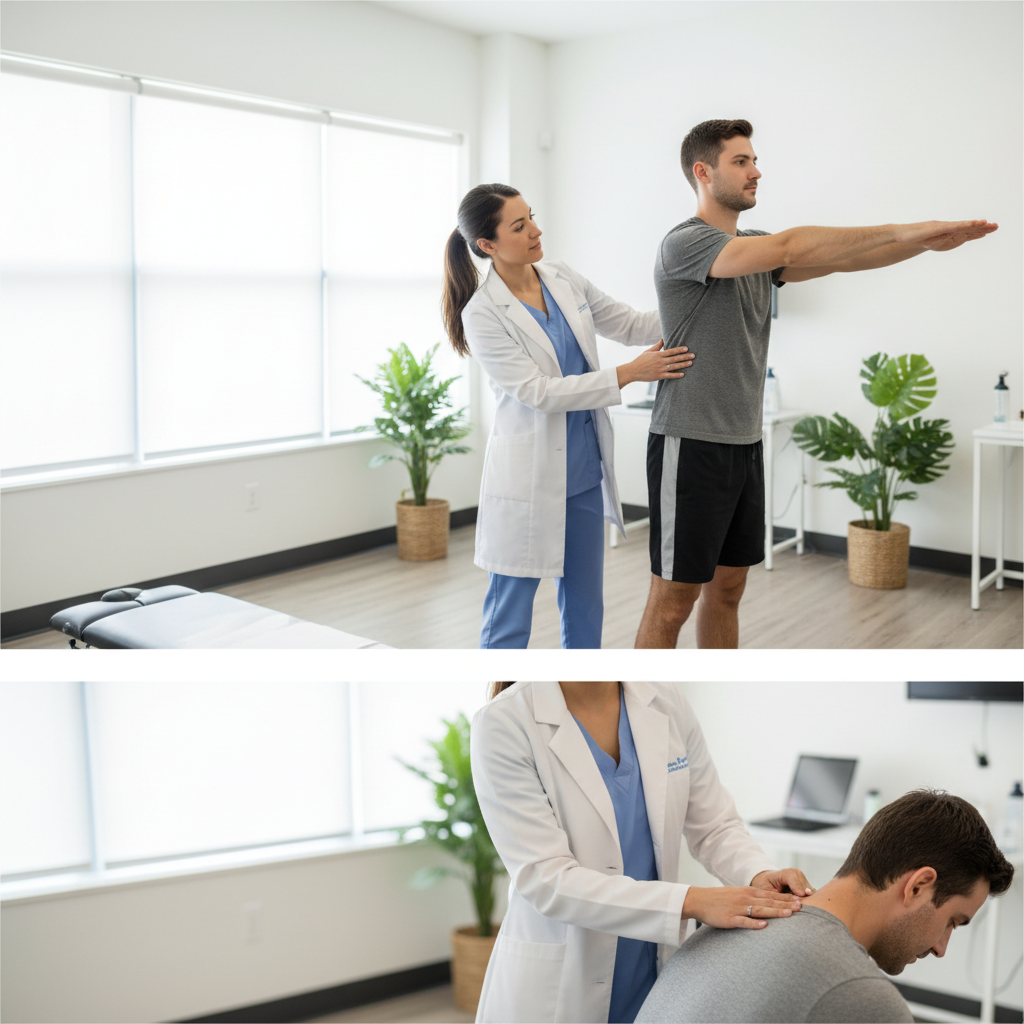
This is why a thorough movement assessment is central to how I practice. Rather than only palpating the painful joint, I evaluate how you squat, hinge, lunge, rotate, and reach. A few examples of what this looks like in my Marlboro office:
The Overhead Squat
Watching a patient perform a bodyweight overhead squat tells me an enormous amount in under a minute—whether the knees cave, whether the heels lift, whether the arms drift forward, whether one side compensates more than the other. Each deviation points toward a specific joint restriction.
Single-Leg Balance and Step-Down Tests
These reveal hip stability issues that don’t show up in double-leg movements, which is often why pain only appears during running or single-leg-dominant lifts, not everyday activity.
Ready to Feel Better? Start for Just $29
Your first visit includes a full exam + X-rays if needed for only $29 — regular fee $189. Same-day appointments available at our Marlboro, NJ clinic.
Valid for new patients only at participating locations. Due to federal regulations, this offer cannot be applied to patients enrolled in Medicare, Medicaid, or other federal healthcare programs. Not valid for ACN members. New Patient offer pricing varies by location. Insurance acceptance varies by location.
Thoracic Rotation Screening
A quick seated rotation test frequently exposes restrictions that are quietly overloading the shoulders or low back during pressing and pulling movements.
These assessments guide everything about the treatment plan. Without them, we’re guessing.
My Chiropractic Treatment Approach
Once I’ve identified the true source of the compensation pattern, treatment typically involves a combination of:
- Chiropractic adjustments to restore proper joint motion where restrictions exist—commonly the thoracic spine, hips, or ankles
- Soft tissue work to release the muscles that have tightened up from overcompensating
- Corrective exercise targeted at the specific mobility or stability deficit uncovered in your movement assessment
- Movement retraining so your body learns the correct pattern instead of defaulting back to the compensation under fatigue or load
This is very different from simply treating the painful joint in isolation. We’re addressing the mechanical reason the pain developed in the first place.
What Patients Can Expect
Most patients notice improved movement quality within the first few visits, even before pain fully resolves—that’s often a good sign the underlying pattern is shifting. Full resolution timelines vary depending on how long the compensation has been in place, but I typically see meaningful progress within four to six weeks of consistent care and home exercise compliance.
At-Home Tips to Support Your Recovery
- Prioritize thoracic mobility with daily rotational stretches, especially if you sit for long stretches at work
- Don’t skip ankle mobility work—limited dorsiflexion is one of the most common hidden contributors to knee pain I see in Marlboro runners and lifters
- Train single-leg stability, not just bilateral lifts, to expose and correct hidden hip weaknesses
- Slow down your warm-up and actually assess how a joint feels before loading it heavily
- Track patterns, not just pain—note which movements or days trigger symptoms
A Local Perspective
I see this pattern constantly among the active population here in Marlboro—parents training for local 5Ks, athletes at the township fields, and members of area gyms pushing through nagging pain instead of addressing its root. Marlboro is an active community, and that’s exactly why a proper movement assessment matters so much here: the demand on your joints is real, and so is the cost of ignoring compensation patterns.
Frequently Asked Questions
How do I know if my pain is from a compensation pattern or an actual injury?
Both can be true at once—a compensation pattern often leads to an actual injury over time. A movement assessment helps distinguish between the two and identifies whether other joints are contributing to the problem.
Can chiropractic care help with exercise pain even if I haven’t been formally diagnosed with an injury?
Yes. Many patients come in with vague, recurring discomfort rather than a diagnosed injury. Identifying and correcting movement dysfunction early often prevents a formal injury from developing.
Is it normal for pain to show up somewhere different than where the actual problem is?
It’s extremely common. Ankle restrictions frequently show up as knee pain, hip restrictions as low back pain, and thoracic spine restrictions as shoulder pain.
Will I need to stop exercising while this is being corrected?
Usually not entirely. In most cases, we modify certain movements or loads while working through corrective exercise, rather than requiring complete rest.
How long does a movement assessment take?
A thorough assessment typically takes 30–45 minutes and includes a review of your training history, current symptoms, and a series of functional movement screens.
What if I’ve already tried stretching the painful area without success?
This is one of the most common scenarios I see. If stretching the symptomatic area hasn’t helped, it’s a strong indicator the true restriction lies elsewhere in the kinetic chain.
Take the Next Step
If you’ve been dealing with exercise-related pain that keeps coming back no matter how much you stretch, rest, or foam roll the “problem area,” it’s time to look at the whole picture. Book a movement assessment at HealthSource Chiropractic of Marlboro, and let’s find the real source of your pain—not just where it hurts, but why.